The Kettle Before the Craft: What UK Makers Curate at the Studio Door
A studio visit is a small piece of theatre. The curtain is the door; the set is the bench; the props are the kettle, the cutting mat and the object left at eye level. None of this is fake. It is editing. And in 2026, as more UK makers sell through Instagram, newsletters and open-studio weekends, that edit has become part of the work itself.
I asked nine makers — from ceramicists to bookbinders — not for a full tour, but for the first three feet of one. What do people see when they walk in? What gets moved, covered or quietly removed before the door opens? The answers were practical, funny and surprisingly revealing about how craft is sold now.
The First Three Feet
A ceramicist in Stoke-on-Trent says the first thing visitors see is not the kiln. It is a shelf of seconds with honest prices. ‘It tells them clay is a material, not a magic trick,’ she says. The bucket of reclaim and the shelf of panic pots go behind a curtain. Not because they are shameful, but because they need context. The seconds shelf does the same job in ten seconds.
A bookbinder in Bristol puts one finished book open on a stand and a spool of thread beside it. The guillotine dust gets wiped down; the pile of failed endpapers goes in a drawer. ‘People don’t need to see every mistake to trust the binding,’ she says. ‘They need to see that I can finish.’
A furniture maker in Glasgow takes a different line. He leaves one plane on the bench and sweeps shavings into a corner — but not out of the room. ‘A completely clean workshop reads like a showroom,’ he says. ‘People relax when they see evidence of work. They just don’t need to see the evidence of a bad week.’
The Useful Half-Finish
A textile maker in Leeds leaves a warp on the loom during open weekends. It is not a staged ruin; it is simply where she is. Visitors ask better questions when they can see the structure. ‘A finished scarf says buy me,’ she says. ‘A warp says ask me how this works.’ The bin of loose ends is hidden. The loom is not.
A printmaker in Cardiff pins a test print with registration marks to the wall. It is the piece that explains the process without a lecture. The misprints go under the bench. ‘The test print says I know what I’m doing,’ he says. ‘The bin says I’m human. You only need one of those at the door.’
A silversmith in Sheffield keeps a tray of rejected settings on the bench. Not the failures that still sting, but the ones that taught her something. The invoices and the cold coffee cups go away. ‘Clients don’t need my admin,’ she says. ‘They need to see that I edit.’
The Privacy Line
A potter in Belfast hides the dog hair and the family photos. She keeps a worn wooden rib and a lump of clay on the wheel head. The distinction matters: the first is private life, the second is working life. ‘A studio is not a confessional,’ she says. ‘It is a place of business with a kettle.’
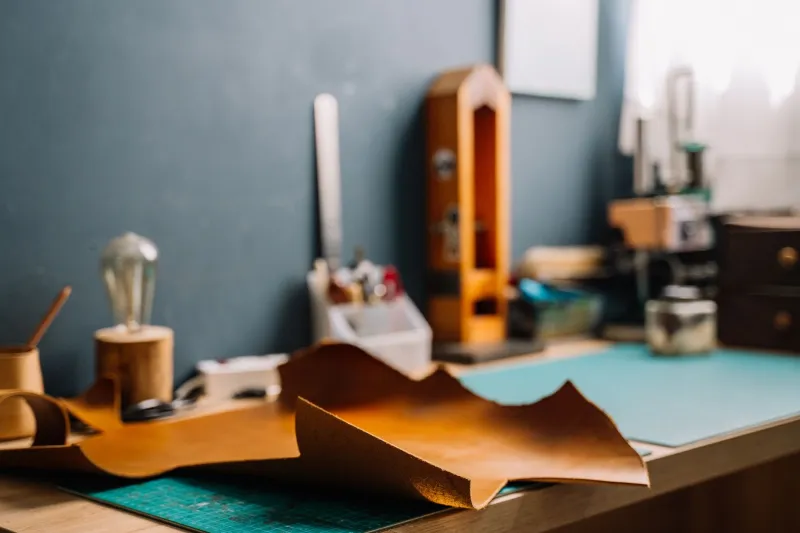
A leatherworker in Norwich once cleared everything away before a client visit. The room looked immaculate. The client asked, politely, whether he actually made the bags himself. Now he leaves a cutting mat with fresh marks and a half-cut strap on the bench. ‘The mess that proves the work is not the same as the mess that slows the work,’ he says.
A glassblower in Edinburgh keeps the warm bench look — the tools, the colour samples, the marver — but hides the graveyard of cracked pieces. ‘It would worry buyers about fragility,’ she says. ‘And it would make the visit about failure rather than care.’
The Story They Take Away
Every maker I spoke to described the same risk from opposite directions. Stage too little and visitors wonder if anything happens here. Stage too much and the visit becomes a performance of labour rather than a portrait of judgement. The sweet spot is not honesty in the raw. It is legibility.
That is why the kettle matters. It says someone works here, someone takes a break here, someone has thought about your comfort. The clear bench says the work is under control. The half-finished thing says the work is alive. The hidden bin says the work is yours to manage, not theirs to inspect.
By the time a client leaves, they are not carrying a memory of every tool. They are carrying a story: this person is careful; this person is practical; this person finishes things. The studio door has done its job. It has not shown everything. It has shown enough.
A threshold is not a facade. It is a form of hospitality — and, for a UK maker in 2026, a quiet piece of brand craft in its own right. The kettle goes on. The door opens. The edit begins.