The Hands You Never See: Seven UK Backstage Specialists on Making It Look Effortless
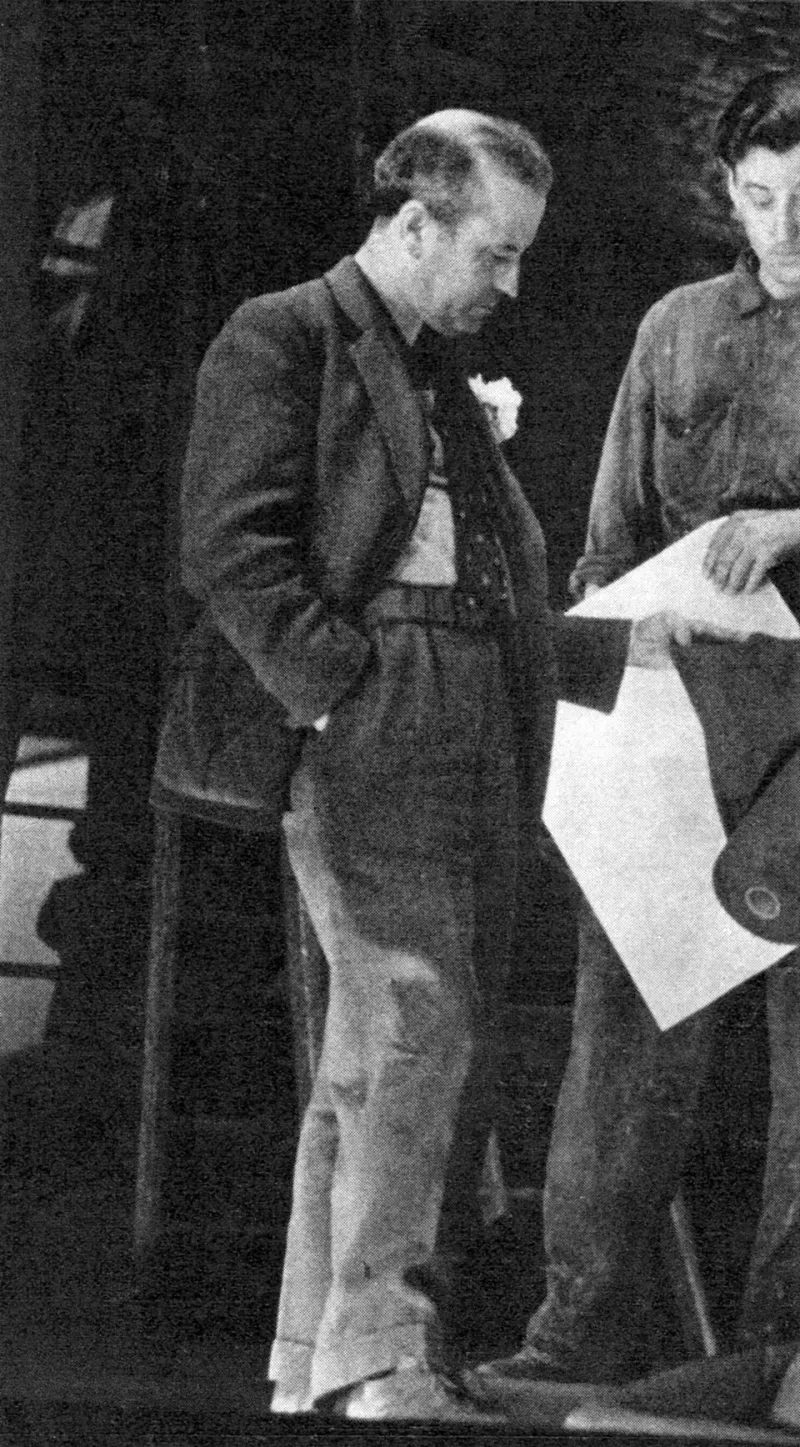
Photo: Stage Publishing Company, Inc.; no photographer credited, Public domain, via Wikimedia Commons
At 4.40pm on a Thursday in a producing theatre in the north west of England, the wardrobe room smells of steam, spray starch and somebody's coffee. Half an hour until the half. Two costumes hang on a rail with the evening's quick change mapped out in tape on the floor: a dress that has to come off in nine seconds, a jacket that has to go on in eleven.
Nobody in the audience will ever think about that tape. Which is, more or less, the job.
British entertainment runs on makers whose craft is measured almost entirely by its absence. When it works, you notice nothing. When it doesn't, you notice nothing else. Over the past few months I've been talking to specialists across live and screen — some in formal interviews, others in the margins of a get-in, shouting over a sound check — and the same phrase kept resurfacing: “If they're talking about us, something's gone wrong.”
The costume cutter: “the fitting is a negotiation”
Priya has cut costumes for regional theatre for fourteen years. Her day started with a returns note and a broken zip, and will end with a repair list for the matinee. “Everyone thinks we make dresses,” she says. “Mostly we make systems. The dress is the easy bit. The system is what makes it come off in nine seconds without taking an earring with it.” Her tool of choice this week: a magnetic closure she has been quietly trialling on a character who has to undress in the dark.
The prop maker: things that must never be seen working
In a workshop two floors up, a wooden pistol is being aged with tea, boot polish and a heat gun. It has to look ancient, weigh almost nothing, break safely on cue and survive forty performances. “On film you make it for one angle,” the maker explains. “On stage you make it for the cheap seats, the wardrobe assistant, the understudy and the fire officer.” Half of the job, he says, is knowing which parts of a prop will never be looked at and building accordingly. The other half is having a second one ready.
The lighting designer: the cue that isn't a cue
Lighting designers talk about “invisible” work in a way that's easy to misread. It isn't an absence of design — it's a design that supports rather than announces itself. A good cue, one told me, is often the one that happens during a laugh so nobody registers it. She spends the tech plotting on a desk with hundreds of channels and ends up using perhaps twelve of them. The rest is insurance. “The show file is a document of all the things we decided not to do.”
The monitor engineer: the mix nobody in the room hears
Front of house gets the glory; monitors get the arguments. A touring monitor engineer for a mid-sized UK act describes his job as “translating between what a performer thinks they sound like and what they can actually hear over a drummer.” He builds a separate world for each musician on stage — a little more vocal here, less bass there — and rebuilds it nightly, because venues change and ears change with them. “If I do it right, four people on stage have a lovely evening and nobody in the audience knows my name.”
The stage manager: two hundred decisions before the interval
By 7.25pm the stage manager has already dealt with a missing shoe, a delivery, a fire door and a note about a lift. During the show she calls the cues from the corner of the wings, one eye on the script and one on a monitor, speaking in the compressed shorthand of the industry: standby, go, hold. “The audience thinks the show is the actors,” she says. “The show is a timetable. Everything else is improvisation around the timetable.”
The scenic artist: painting for twenty metres, not two
A scenic artist working on a touring set explains that scale is the whole discipline. Brushwork that looks crude in the studio reads as texture from row twelve of the circle. She paints with a photograph of a real wall pinned up beside her and a view from the back of a theatre in her head. “You're not making a picture. You're making an impression of a picture from a specific distance, for two hours a night, for eight weeks.”
The Foley artist: the sound of a coat on a chair
On the screen side, a Foley artist in a London studio is performing a scene in real time — footsteps, a coat, a cup, a door — in sync with a picture that is being projected on the wall. She has a floor of gravel, a box of cutlery and a shelf of shoes. The craft is precision plus imagination: a swan's wing might be a leather glove; a broken arm might be snapped celery. “People think Foley is old-fashioned,” she says. “It's the fastest way to make something feel true. Libraries give you a sound. This gives you a performance.”
The quiet arithmetic of craft
What links these seven jobs is not romance. It's arithmetic: a budget, a deadline, a safety threshold, a set that has to fit into a lorry by midnight. Every one of them described improvisation as a core skill and every one described the same constraint — there is never quite enough time. The magic isn't spontaneous. It's a hundred small, unglamorous decisions made before anyone claps.
There's also a quiet professional pride that doesn't always get an outlet. Nobody I spoke to wanted a standing ovation. Most of them wanted the same three things: to be credited properly, to be consulted early rather than late, and to be given enough time to do the job well.
What audiences and aspiring makers can do with this
If you want to value craft over spectacle, start with three small habits. Read the crew list — in the programme, in the credits, on the venue's website — and notice the names of the people who built what you're watching. Stay for the get-out once in a while, or at least clock the fact that the building is being dismantled while you're finding your coat. And if you're hoping to make this your work, look sideways at the roles nobody mentions on the poster: there are apprenticeships, trainee schemes and short courses in wardrobe, automation, sound and stage management across the UK, and far fewer applicants per place than there are for the front of the stage.
The audience sees the trick. Somebody had to build the table it happens on. That's the craft — and it deserves better than invisible.